Decoding the cryptic language of ribonucleotide incorporation in human nuclear DNA

Ribonucleotides, the building blocks of RNA, can become embedded in DNA and have traditionally been viewed as accidental errors generated during DNA synthesis. With support from the Mathers Foundation, the Storici laboratory investigated whether these molecules instead serve a functional role in the human genome.
In a study published in Cell, the team discovered approximately one million embedded ribonucleotides in each human nuclear genome and found that they form a highly organized landscape, which they term the human nuclear “ribome.” Rather than being randomly distributed, these ribonucleotides are concentrated near the starting points of active genes and other important genomic features, while their abundance scales with gene activity.
The researchers further showed that cells actively process these ribonucleotides in ways that influence DNA supercoiling, the twisting and coiling of DNA associated with transcription. These findings reveal an unexpected connection between DNA-embedded ribonucleotides, DNA topology, and gene activity, suggesting that molecules once thought to be simple mistakes may have broader biological functions in the genome.
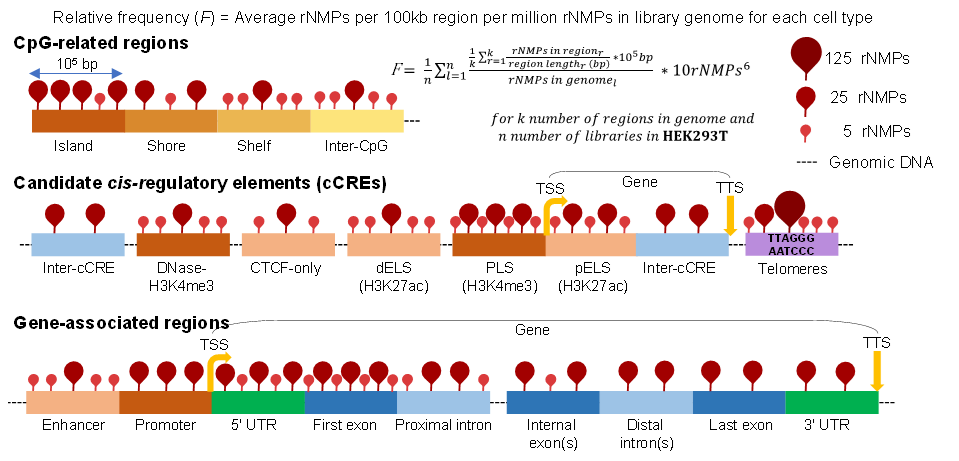
The human nuclear ribome. Schematic representation of the non-random distribution of DNA-embedded ribonucleotides across different features of the human nuclear genome. Red markers represent embedded ribonucleotides, with their size indicating relative abundance across genomic regions. The distinct patterns illustrate the organization of these ribonucleotides into a genomic landscape termed the human nuclear “ribome.”
Read the full article here. Paid subscription to Cell required.