Spring 2026 Grantee Highlight:
Michael Berney
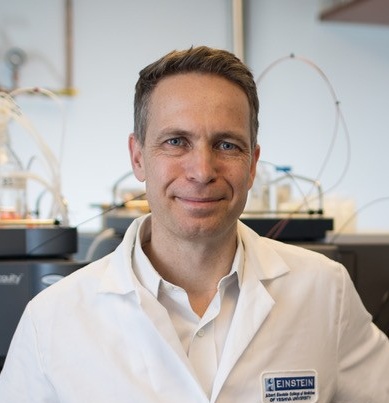
Michael Berney, PhD
Associate Professor, Department of Microbiology & Immunology, Albert Einstein College of Medicine
Tuberculosis (TB) remains one of the world’s deadliest infectious diseases, claiming more than a million lives each year. Despite decades of research, scientists still do not fully understand how Mycobacterium tuberculosis adapts to the nutritional environments it encounters within the human body. Michael Berney and his team are investigating a newly recognized form of genome plasticity that could play a role in how the bacterium responds to changing conditions.
The Berney Lab studies large, reversible chromosomal duplications that arise and disappear depending on available nutrients. Their research has shown that these events, known as Phase-variable Adaptive Copy Expansions (PACEs), are triggered by specific metabolic bottlenecks and can alter bacterial growth on different carbon sources, change drug susceptibility profiles, and occur across globally circulating TB lineages. Importantly, PACEs are largely invisible to the standard sequencing methods commonly used in research and clinical laboratories, helping explain why their biological significance has remained overlooked.
Berney and his team will identify the nutrient signals that trigger these genome rearrangements, characterize how PACEs reshape bacterial physiology, and determine how widespread they are among TB strains worldwide. This work aims to reveal a previously hidden form of genome plasticity in M. tuberculosis and provide new insights into pathogen adaptation, with the potential to inform future strategies for combating one of humanity’s oldest and most persistent infectious diseases.
Learn more about the Berney Lab: https://www.berneylab.org